

Table of Contents
- Why Upgrading to Projector Headlights Improves Night Visibility
- LED vs HID Projector Performance: Which Technology Suits Your Drive?
- ADR Compliance for Automotive Lighting: What You Must Check Before Buying
- Headlight Beam Pattern Adjustment and Cut-off Lines Explained
- Step-by-Step: Retrofit Kit vs Plug-and-Play Projector Headlights
- Thermal Management and Heat Dissipation in Projector Housings
- Top Picks: Where to Buy High Quality Projector Headlights Online
- Conclusion: Making the Right Choice for Your Vehicle
- Frequently Asked Questions
Last Updated: October 2, 2026
Why Upgrading to Projector Headlights Improves Night Visibility
Most factory halogen reflectors scatter light rather than direct it. A projector headlight solves that by focusing the beam through a lens, which is why drivers upgrading to projector headlights report sharper, longer low-beam reach on unlit roads.
The difference comes down to beam control. A reflector housing bounces light in multiple directions, wasting output above the cut-off where it does nothing but glare at oncoming traffic. A projector assembly concentrates that same output into a defined pattern. The result: more usable light on the road, less wasted scatter.
Projector headlights are headlight assemblies that use a curved lens and internal shield to focus light into a controlled beam pattern with a sharp cut-off line.
That definition matters because "projector" describes the optics, not the bulb. You can run halogen, HID or LED inside a projector housing, and each behaves differently.
LED vs HID Projector Performance: Which Technology Suits Your Drive?
LED wins for daily driving in most cases. HID still holds an edge in raw long-distance throw, but modern LED projectors have closed that gap while adding instant-on response and lower power draw. The reason comes down to how each source actually makes light.
An HID bulb fires an electrical arc through a metal-halide gas mixture. That arc takes 3-10 seconds to reach full brightness and needs a ballast to strike and then regulate the voltage. An LED projector uses semiconductor diodes that emit light the instant current flows, driven by a constant-current driver rather than a ballast. No warm-up, no strike voltage, no re-strike delay if you flash your high beams.

Here's how the two compare in practice:
| Factor | LED Projector | HID Projector |
|---|---|---|
| Warm-up time | Instant | 3-10 seconds to full output |
| Colour temperature | Typically 6000K | 4300K-6000K, shifts with bulb age |
| Power draw | Lower, often 25-35W per side | Higher, typically 35-55W plus ballast losses |
| Lifespan | Long, diodes dim gradually | Shorter, arc colour shifts as the capsule ages |
| Retrofit complexity | Simpler, driver inline | Ballast wiring and mounting needed |
| Re-strike behaviour | Instant | Hot re-strike can lag or fail |
HID conversion kits require ballasts and careful bulb matching, and a poorly matched HID bulb in the wrong housing produces glare and hot spots. The arc inside an HID capsule sits at a different focal point to a halogen filament, so a projector designed for halogen will scatter HID output unless the optics are matched. LED drop-ins are more forgiving on focal point, though cheap ones flicker or trigger dash warnings without a canbus-friendly driver.
What most guides miss: colour temperature is not brightness.
ADR Compliance for Automotive Lighting: What You Must Check Before Buying
ADR compliance for automotive lighting is the non-negotiable part of this purchase. Australian Design Rules govern what lighting your vehicle may legally run on public roads, and an aftermarket assembly that isn't compliant can fail a roadworthy inspection or attract a defect notice.
The practical checks before you buy:
- Confirm the assembly is ADR-compliant for your vehicle category
- Check the beam pattern produces a correct cut-off with no upward glare
- Verify colour temperature and output stay within the allowed range for the fitting
- Keep the light source matched to the housing it was designed for
Headlight Beam Pattern Adjustment and Cut-off Lines Explained
Beam pattern adjustment is what separates a professional-looking upgrade from one that blinds everyone. The cut-off line is the horizontal edge where light stops, keeping illumination on the road and out of oncoming drivers' eyes. Understanding why that edge exists makes the adjustment process far easier to get right.
Alignment basics:
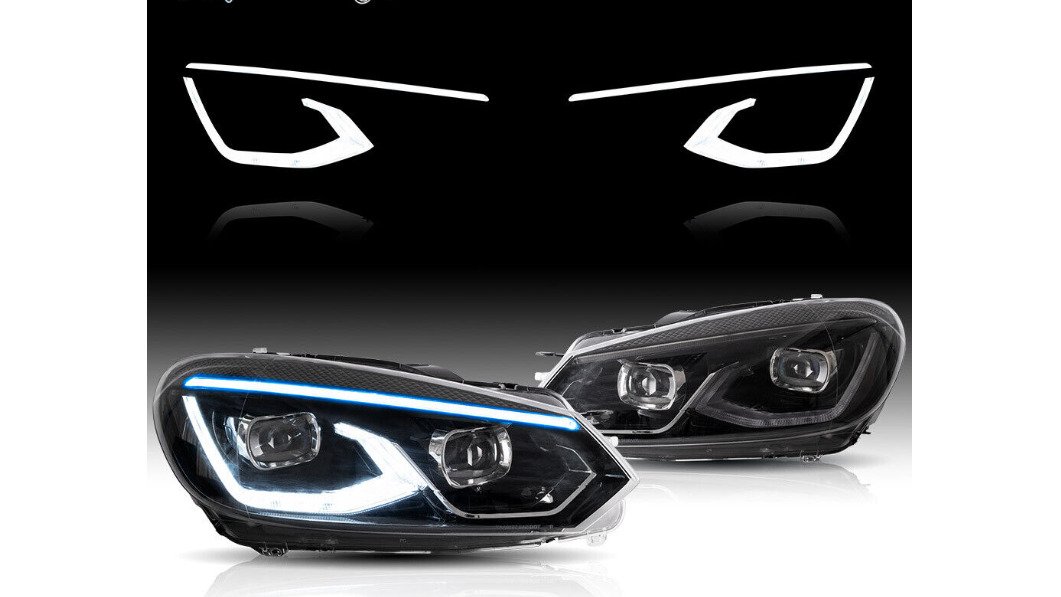
Blue DRL LED Headlights For Volkswagen →
- Park on level ground facing a wall 5-7 metres away
- Mark the vertical centre of each headlight on the wall
- Check the cut-off sits slightly below the headlight centre height
- Adjust horizontally so both beams point straight ahead
- Re-check with the vehicle loaded as you normally drive it
Step-by-Step: Retrofit Kit vs Plug-and-Play Projector Headlights
Plug-and-play is the better route for most buyers. A full retrofit kit means opening your existing housing, mounting a projector inside, and sealing it back up. A plug-and-play assembly replaces the whole housing and connects to your factory harness.
Before ordering, confirm:
- Your exact model year and trim
- Whether your car left the factory with halogen or projector housings
- Whether the listing explicitly excludes your variant
Thermal Management and Heat Dissipation in Projector Housings
Heat is the quiet killer of aftermarket lighting. LEDs run cooler than halogens at the bulb, but the driver circuitry and the tight confines of a projector housing still generate heat that has to escape.
Look for these build signals:
- Heat-resistant PMMA lens rather than basic plastic
- Aluminium internal components for heat spreading
- A proper waterproof rating, since sealed units handle both moisture and thermal cycling better
- An IP67 rating, which indicates the housing is fully sealed against dust and water
Top Picks: Where to Buy High Quality Projector Headlights Online
A quick selection guide:
| Your Priority | What to Look For | Why |
|---|---|---|
| Easy install | Plug-and-play, OEM connectors | No cutting or coding |
| Longevity | PMMA lens, aluminium internals | Better heat handling |
| Weather resistance | IP67 rating | Sealed against dust and water |
| Modern look | Start-up animation, sequential signals | Style plus signalling clarity |
What sets a specialist apart from a general retailer is the fitment guidance. A seller who tells you which variants are excluded is doing the work that prevents a return.

Conclusion: Making the Right Choice for Your Vehicle
The hard part of buying projector headlights isn't choosing LED over HID or picking a colour temperature. It's confirming fitment and compliance before you spend anything. Get those two right and the visibility gain is real and immediate.
Frequently Asked Questions
What is the difference between Bi-LED and standard projector headlights?
Bi-LED projector headlights use a single LED projector unit that handles both low and high beam functions through a movable shield or dual-chip design. Standard projector headlights typically use separate bulbs for high and low beam, often halogen or HID. Bi-LED setups offer faster warm-up, lower power draw, and longer lifespan because there are no filaments to burn out. They also produce a more consistent beam pattern across both modes, which helps with glare reduction and beam focus on the road.
Are aftermarket projector headlights ADR compliant?
Not all aftermarket projector headlights meet ADR compliance for automotive lighting. To be road-legal, they must meet the relevant Australian Design Rules for light distribution, beam pattern, and cut-off lines. Look for products that state ADR compliance or carry an E-mark approval. Plug-and-play units designed as OEM replacements for specific models are more likely to comply than universal retrofit kits. Always check the listing for compliance claims and confirm with your state's road authority before installing.
How do I choose the right colour temperature for my headlights?
Colour temperature affects both visibility and appearance. A 4300K output gives a warm white light that performs well in rain and fog because it penetrates moisture better. A 6000K output produces a crisp white light that many drivers prefer for its modern look and sharp contrast on clear nights. Avoid temperatures above 8000K, as they shift toward blue and reduce usable light on the road. For a balance of style and function, 6000K is the most common choice for projector headlights.
What should I look for when buying automotive lighting online?
Check five things before buying: fitment compatibility with your exact make, model, and year; whether the listing confirms ADR compliance; the waterproof rating (IP67 or higher is ideal); whether it is plug-and-play or requires a retrofit kit; and the warranty terms. Also look for a clear return policy in case the units arrive damaged or do not fit. A one-year manufacturer warranty is a good baseline for projector headlights.
Will aftermarket LED projector headlights cause dashboard error messages?
Some LED upgrades trigger CANBUS errors because the vehicle's computer detects a different power draw than the factory halogen or HID bulbs. Plug-and-play projector headlights designed for your specific model often include built-in CANBUS decoders or resistors to prevent flickering and warning lights. If the listing does not mention CANBUS compatibility, ask the seller before buying. Models that are direct OEM replacements for your vehicle are less likely to cause errors than universal fit options.
How long do projector headlights typically last?
LED projector headlights generally last between 30,000 and 50,000 hours of use, which often exceeds the life of the vehicle. HID projector bulbs typically last around 2,000 to 3,000 hours before needing replacement. The housing assembly, lens clarity, and thermal management design also affect longevity. Look for units with aluminium heat sinks and IP67 waterproof ratings to protect against moisture and dust, which are the main causes of premature failure in aftermarket lighting.