

Table of Contents
- How Aftermarket LED Headlights Change What You See at Night
- Halogen vs LED Headlight Visibility: What the Difference Actually Looks Like
- ADR compliance for LED headlights: What Australian Road Rules Require
- How to Adjust LED Headlights to Avoid Glare
- Heat Dissipation, Lifespan and Power Draw: The Trade-Offs Nobody Mentions
- Compatibility and Installation: What to Check Before You Buy
- Frequently Asked Questions
Last Updated: September 16, 2026
How Aftermarket LED Headlights Change What You See at Night
Do aftermarket LED headlights improve visibility? Yes, when they are quality units matched to your vehicle and aimed correctly. A well-built LED conversion produces a brighter, whiter and wider spread of light than a tired halogen globe, which makes road markings, signs and hazards easier to pick up after dark. This guide from Autoglo Australia explains where the real gains come from, where cheap kits fall short, and how to stay on the right side of the rules.
The honest answer is that aftermarket LED headlights improve visibility only when three things line up: the beam pattern, the colour temperature, and the installation. Get those right and the difference is obvious. Get them wrong and you have spent money to blind other drivers while seeing less yourself.
Here is the part most guides skip. A brighter globe in a housing that was never designed for it does not automatically throw more usable light down the road. It can scatter it.
That is why we look at beam control first, not brightness claims.
Halogen vs LED Headlight Visibility: What the Difference Actually Looks Like
Halogen vs LED headlight visibility comes down to how the light is produced and controlled. A halogen globe heats a tungsten filament until it glows, throwing a warm, yellowish beam. An LED array fires light from small diodes, and in a good housing that light is shaped by precision optics into a tighter, whiter pattern.
The practical differences drivers notice:
- Colour temperature: halogen globes typically sit around 2800-3200K (warm yellow-white), while most road-legal LED upgrades sit in the 5000-6000K band, which is closer to daylight and easier on the eye over long night drives.
- Beam distance: a focused LED beam reaches further down the road than a tired halogen globe of the same nominal output, because more of the emitted light is directed into the usable beam rather than spilled around it.
- Consistency: LEDs hold their output as they age, while halogen globes dim gradually as the filament degrades, often going unnoticed until the globe fails.
- Warm-up: halogen globes reach full output almost instantly; LEDs do too, but some cheap drivers have a brief flicker on start-up that a quality unit eliminates.
Beam Pattern and Focus Precision
Beam pattern is the single biggest factor in whether an LED upgrade helps or hurts. A halogen reflector is shaped around a filament that emits light in every direction. An LED chip emits from a small, flat surface, so the reflector or projector has to be matched to that source.
When the source and the housing match, you get a crisp cutoff and light where you need it. When they do not, the beam scatters upward into oncoming traffic and leaves dark patches on the road.
This is why a cheap kit that "fits" can still perform badly. Fit is not the same as focus. A globe that physically slots into the housing can still sit the LED chip at the wrong depth or angle relative to the reflector, and that alone is enough to ruin the beam.
Colour Temperature and Eye Strain
Colour temperature describes how warm or cool the light looks, measured in kelvin. Halogen globes sit in a warm range, while most LED upgrades sit in a cooler, whiter band that mimics daylight more closely.
Whiter light can reduce the eye strain some drivers feel at night, because the eye works less to resolve detail under a cooler source. Push too far into the blue end, though, and glare and fatigue can get worse rather than better. A balanced white light is the sensible target.
Why "Brighter" Is Not the Same as "Better"
This is the point most comparisons miss. A higher lumen figure on the box does not guarantee more usable light on the road. Lumens measure total light emitted, not how much of it lands in the beam where you need it. A well-focused 2000-lumen LED can put more usable light down the road than a poorly focused 6000-lumen unit that sprays light into the trees and into oncoming drivers' eyes.
That is why the honest comparison is not halogen vs LED in the abstract, it is a matched, focused LED system vs a tired halogen globe. Match the source to the housing, aim it correctly, and the gain is real. Skip either step and the "upgrade" can leave you seeing less than before.
ADR compliance for LED headlights: What Australian Road Rules Require
ADR compliance for LED headlights means your lighting must meet the Australian Design Rules that govern vehicle lighting, and in most cases that means using a compliant, properly aimed unit rather than a loose globe swap into a housing that was never approved for it.
The rules exist for a reason: an uncontrolled beam is a hazard to every driver coming the other way. Before buying, it is worth checking the current requirements through the National Transport Commission vehicle standards and your state or territory road authority, because enforcement and inspection rules can differ by jurisdiction.
What this means in practice:
- Choose lighting sold as compliant for road use, not "off-road only" kits you intend to run on the street.
- Keep your original parts if you may need to revert for a roadworthy inspection.
- Check your state or territory authority's guidance, since requirements and enforcement vary.
A conversion that looks great but fails a roadworthy is money wasted. Compliance is not the boring part; it is the part that keeps you legal and insurable.
How to Adjust LED Headlights to Avoid Glare
To adjust LED headlights to avoid glare, aim them against a wall on level ground and set the cutoff so the beam stays below the eye line of oncoming drivers.
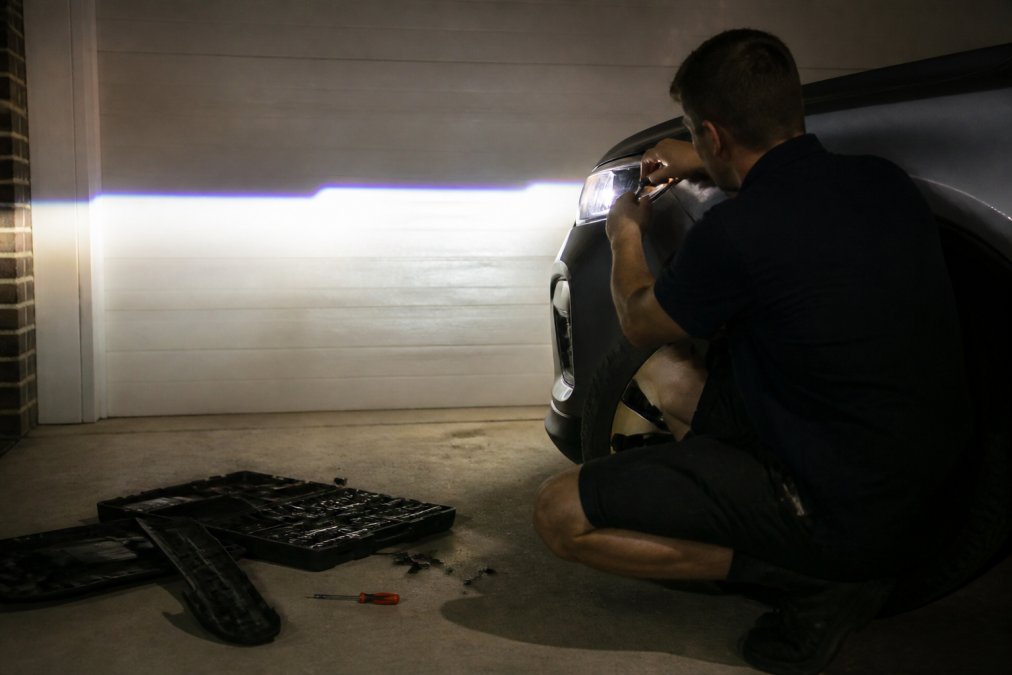
A simple aiming routine:
- Park on level ground a few metres back from a flat wall.
- Mark the centre height of each headlight on the wall.
- Adjust so the top of the beam sits slightly below those marks.
- Check the cutoff is level, not tilted up on one side.
- Take a short drive and confirm you are not flaring into oncoming traffic.
Heat Dissipation, Lifespan and Power Draw: The Trade-Offs Nobody Mentions
| Trade-off | What goes wrong | What to do |
|---|---|---|
| Heat dissipation | Output fades, flickering, early failure | Choose units with proper heatsinks or fans |
| Power draw and CANbus | Dashboard error messages | Use CANbus-ready modules where needed |
| Beam focus | Glare and dark patches | Match the unit to your housing type |
| Compliance | Roadworthy or defect issues | Fit compliant, correctly aimed lighting |
Compatibility and Installation: What to Check Before You Buy
Compatibility is where most returns start.
Reflector vs Projector: Why It Changes Everything
A reflector housing bounces light off a shaped mirror surface to form the beam.
CANbus, Flickering and Dashboard Error Codes
- Dashboard warning: a bulb-out or headlight error message appears even though the light works.
- Flickering: the car pulses current to test the circuit, and the LED flickers in response.
- Hyperflash or no start: in some vehicles the light simply will not illuminate without a load resistor or CANbus-ready module.
A Short Pre-Purchase Checklist
- Confirm fitment for your exact make, model and year
- Identify your housing type: reflector or projector lens
- Check whether your vehicle needs a CANbus module or load resistor to avoid warning lights and flickering
- Confirm the unit is sold as compliant for road use
- Keep your original parts for inspections
Installation: What "Plug-and-Play" Really Means
Installation is usually plug-and-play for a matched kit, but "plug-and-play" assumes the parts were matched in the first place.
Frequently Asked Questions
Are aftermarket LED headlights legal in Australia?
They can be, but only if they meet the relevant Australian Design Rules and state road rules. The key requirements are a compliant beam pattern, correct colour temperature (around 6000K or lower), and no excessive glare for oncoming traffic. Many cheap kits fail these tests because their beam pattern scatters light. Always check that the product you buy is ADR-compliant and keep your original halogen bulbs for rego inspections.
Do LED headlights provide better distance visibility than halogen?
Yes, in most cases. LED headlights produce more lumens per watt and a whiter light that reflects off road markings and signs more effectively. A well-designed LED projector or reflector housing can throw light further down the road than a standard halogen bulb. The catch is beam focus: a poorly designed LED kit can actually reduce usable distance because the light scatters rather than projecting forward.
What are the downsides of installing cheap LED headlight kits?
Common problems include scattered beam patterns that blind other drivers, flickering caused by CANbus errors, overheating because of poor heat dissipation, and short lifespan. Cheap kits often skip thermal management and precision optics, which are the two components that make LED upgrades work. You may also get dashboard warning lights or radio interference. Spending a bit more on a quality conversion kit usually avoids these issues.
Is there a difference in beam pattern between halogen and LED bulbs?
Yes, and it is the most important difference. Halogen bulbs emit light in all directions from a filament, while LEDs emit from a small chip on one side. If the LED chip is not positioned to match the halogen filament's focal point, the reflector or projector cannot focus the beam correctly. This causes glare for oncoming traffic and reduces your own visibility. Quality LED kits are designed to replicate the original focal point.
Upgrading your lighting should make night driving safer, not more complicated. Autoglo Australia stocks premium LED headlights and projector headlights across a wide range of makes and models, with monthly featured product sales and specialised accessories to match your build. If you want lighting that is focused, compliant and built to last, browse the range and get the fitment advice you need before you commit. Get started with Autoglo Australia and see the road more clearly after dark.