

Table of Contents
- When Aftermarket LED Headlights Actually Void Your Warranty
- ADR Headlight Compliance Standards: What Your Upgrade Must Meet
- How to Check If LED Bulbs Are ADR Approved Before You Buy
- Can Poor Headlight Alignment Cause Accidents?
- The Insurance Trap: When a Voided Warranty Becomes a Voided Claim
- Retrofitting vs. Replacement: Which Upgrade Protects Your Coverage?
- Conclusion
- Frequently Asked Questions
Last Updated: September 21, 2026
When Aftermarket LED Headlights Actually Void Your Warranty
The short answer: an aftermarket LED headlight upgrade does not automatically void your whole warranty, but it can void the specific parts it touches. In Australia, your rights sit under the Australian Consumer Law, and manufacturers cannot blanket-void a warranty just because you fitted a non-genuine part.
Here's where it gets messy. If a dealer can show your LED conversion caused the failure you're claiming, they can refuse that particular claim. The electrical circuit, the headlight housing, and the connectors are the usual casualties. Your engine, transmission, and driveline are almost never affected by a lighting change, so a blanket refusal on those is on shaky ground.
This guide breaks down exactly when a warranty claim survives a headlight upgrade, and when it doesn't. We'll cover ADR compliance, insurance implications, and the checks that separate a safe retrofit from a rejected claim.
The critical distinction most owners miss is causation. A manufacturer or dealer must link the modification to the fault. They can't simply point at your aftermarket LED headlights and walk away from an unrelated repair.

ADR Headlight Compliance Standards: What Your Upgrade Must Meet
ADR headlight compliance standards are the technical rules your vehicle's lighting must satisfy to be legally roadworthy. In Australia, these sit under the Australian Design Rules administered by the National Transport Commission, with the relevant instruments being ADR 13/00 (installation of lighting and light-signalling devices) and ADR 46/00 (headlamps). Together they govern beam pattern, intensity, light distribution and the markings a compliant lamp must carry.
Any upgrade you fit must still meet the photometric requirements that applied when your vehicle was built. That means the correct beam cutoff, the right luminous flux, and a light distribution pattern that doesn't blind oncoming drivers. A globe that produces more light than the housing was designed for can scatter the beam and breach these rules.
The regulatory framework is enforced by state and territory road authorities, and the National Transport Commission's vehicle standards guidance sets out how modifications are assessed. This is where vague legal language meets hard technical limits.
Four parameters matter most here:
- Beam pattern and cutoff: the shape and direction of light thrown onto the road, including the asymmetric step that keeps light low on the oncoming side. It must match the original design.
- Luminous flux (lumens): the total light output. A halogen housing is typically engineered around roughly 1,000-1,500 lumens per low beam; dropping in a globe rated far above that overwhelms the reflector and scatters light.
- Colour temperature (Kelvin): the whiteness of the light. Factory halogen sits around 3,000-3,200K and factory LED/HID around 4,300-6,000K. Very high Kelvin ratings (often marketed as 8,000K+) shift the light toward blue, reduce usable output in rain and fog, and fall outside what most state inspections accept.
- Compliance markings: a compliant lamp or assembly carries an approval mark, typically an E-mark (ECE homologation, e.g. E1 for Germany) or an equivalent ADR approval number stamped on the housing or lens. A bulb with no marking on the base or packaging is not a compliant replacement.
Get any of these wrong and you're non-compliant, regardless of how good the light looks. The practical test is simple: if the housing wasn't homologated for the light source you're fitting, the beam pattern almost certainly won't meet ADR 13/00 and ADR 46/00.
How to Check If LED Bulbs Are ADR Approved Before You Buy
Checking whether LED bulbs are ADR approved means verifying the product carries recognised compliance markings and matches your vehicle's original specifications. There is no single "ADR approved" sticker, so you need to look at the certification the manufacturer provides.
Start with the packaging and the product listing. Look for ECE certification or an equivalent compliance mark, and confirm the Kelvin rating and luminous flux match what your housing was designed to accept.
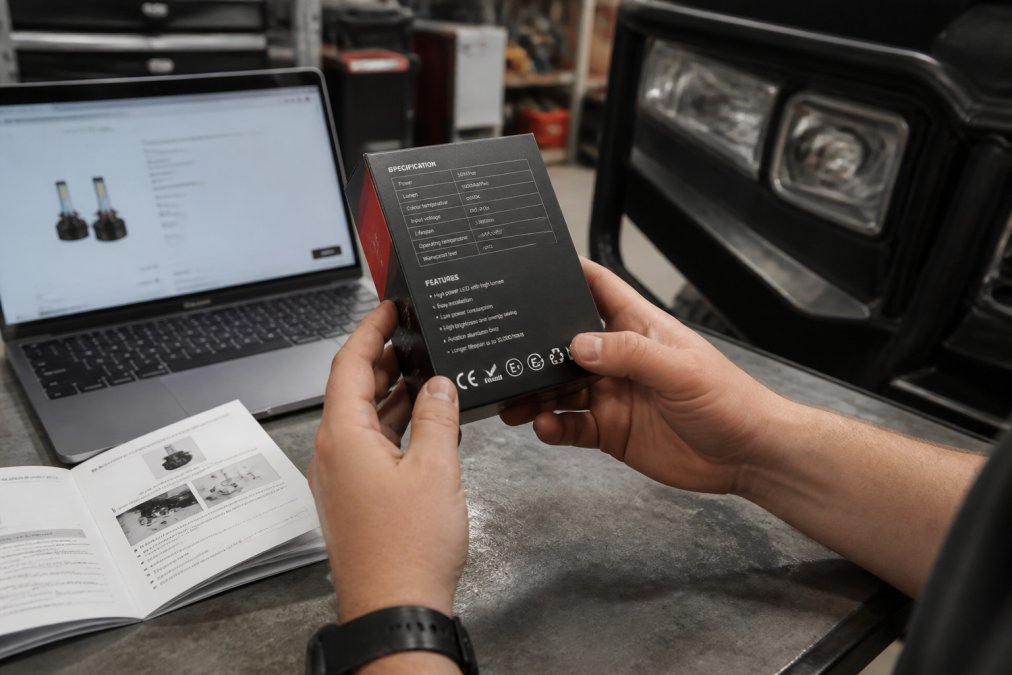
A common mistake is buying a globe rated far brighter than the factory unit. More light output sounds like an upgrade, but if the reflector housing can't focus it, you get glare instead of usable beam. That's a defect notice waiting to happen.
Use this checklist before you commit:
- Confirm the product lists ECE certification or a recognised compliance mark
- Match the Kelvin rating to your vehicle's original specification
- Check the luminous flux does not exceed what your housing handles
- Verify fitment against your exact make, model, and year
- Confirm the seller accepts returns if the beam pattern fails inspection
Where the globe is a direct replacement for a halogen unit, the safest path is a complete assembly designed for your model rather than a bulb swap into an old housing.
Can Poor Headlight Alignment Cause Accidents?
Yes. Poor headlight alignment can cause accidents because a misaimed beam either fails to illuminate the road ahead or blinds oncoming drivers. Both outcomes reduce reaction time and increase collision risk.
When a beam points too high, it throws glare into the eyes of approaching traffic. When it points too low, your stopping distance effectively shrinks because you see hazards later. Beam alignment is not a cosmetic detail; it's a safety function.
The Australian Road Safety Foundation's guidance on vehicle visibility notes that lighting condition directly affects a driver's ability to detect hazards at night. A correctly aimed beam puts light where you need it and keeps it out of everyone else's eyes.
After any headlight conversion, get the beam alignment checked. A workshop with photometric testing equipment can confirm your light distribution meets the required pattern. This step is cheap compared to the cost of a crash or a rejected insurance claim.
The Insurance Trap: When a Voided Warranty Becomes a Voided Claim
A voided warranty is annoying. A voided insurance claim is expensive.
- Queensland: lighting is checked during the roadworthy certificate (safety certificate) process, and Transport and Main Roads inspectors can issue a defect notice on the spot. A vehicle with non-compliant headlights will fail a safety certificate.
- New South Wales: annual pink slip inspections include a lighting check, and the Environment Protection Authority and Transport for NSW both take an interest in glare complaints.
- Victoria: roadworthy certificates issued by licensed testers include a lighting assessment, and VicRoads can require a vehicle to be re-inspected after a defect notice.
- South Australia: police can issue a defect notice, and the vehicle must be presented for inspection at a Service SA or authorised inspection station before the notice is cleared.
- Western Australia: the Department of Transport's vehicle examination process covers lighting, and defect notices require a re-inspection before registration can continue.
This is the strongest argument for buying compliant parts in the first place. A cheaper globe that fails inspection costs far more when it drags an insurance claim down with it.
Retrofitting vs. Replacement: Which Upgrade Protects Your Coverage?
Replacement wins on coverage. A complete headlamp assembly designed for your model protects your warranty and insurance position far better than retrofitting a bulb into an existing housing.
| Approach | Compliance Risk | Warranty Impact | Best For |
|---|---|---|---|
| Bulb retrofit | Higher, housing not designed for LED | Can void housing and electrical claims | Budget upgrades on compatible housings |
| Complete assembly | Lower, engineered for LED | Protects unrelated components | Owners wanting compliance and coverage |
Conclusion
The real risk with aftermarket LED headlights isn't the upgrade itself; it's fitting a non-compliant part and discovering the problem only when you need a warranty or insurance claim to come through. Compliance, alignment, and paperwork are what protect you.
Frequently Asked Questions
Does changing headlight bulbs void new car warranty?
Not automatically. Under Australian Consumer Law, a manufacturer can only refuse a warranty claim if it proves the aftermarket part caused the fault. If you fit ADR-approved aftermarket LED headlights and an unrelated component fails, your warranty remains valid. The risk arises when a non-compliant part leads to electrical damage or safety defects, which gives the dealer grounds to deny that specific claim.
Are aftermarket headlights legal in Australia?
They are legal only if they meet the relevant Australian Design Rules and are fitted correctly. This means the headlight must carry ADR approval, produce the correct beam pattern, and not exceed intensity limits. Many cheap LED globes sold online fail these requirements. Always verify the product listing states ADR compliance and check for a compliance plate or ECE certification before purchasing.
How do I ensure my aftermarket lighting is compliant?
Start by choosing a complete headlamp assembly that carries ADR approval rather than a plug-in globe. Check the product documentation for photometric testing results and beam cutoff specifications. After installation, have the beam alignment professionally adjusted. Keep all receipts and compliance paperwork. If you are unsure, contact the supplier for the ADR approval number and confirm it matches your vehicle's make, model, and year.
Can poor headlight alignment cause accidents?
Yes. Misaligned headlights reduce your view of the road ahead and can dazzle oncoming drivers, increasing crash risk. A beam aimed too high creates glare that temporarily blinds others, while a beam aimed too low shortens your reaction time. Regular alignment checks, especially after fitting aftermarket LED headlights, are a simple way to maintain road safety and avoid a defect notice.
Before you upgrade, confirm the assembly is engineered for your exact model rather than retrofitted into a housing that was never designed for it. Browse the Autoglo Australia range, check the fitment for your vehicle, and get started with a compliant lighting upgrade that protects both your visibility and your coverage.