

Table of Contents
- Energy Efficient Car Lighting Benefits That Actually Show Up on the Road
- LED vs Halogen Headlights: Why the Gap Is Bigger Than You Think
- LED Headlights Power Consumption: What It Means for Your Alternator and Battery
- LED Headlight Lifespan: Fewer Replacements, Less Fiddling
- Aftermarket LED Headlight Legality Australia: What You Need to Know Before You Buy
- Compatibility, Installation and Total Cost of Ownership
- Conclusion: Choosing Energy Efficient Car Lighting That Fits Your Vehicle
- Frequently Asked Questions
Last Updated: October 9, 2026
Energy Efficient Car Lighting Benefits That Actually Show Up on the Road
Energy efficient car lighting is the shift from halogen bulbs to LED systems that draw less current from your vehicle's electrical system while producing more usable light.
The biggest gain isn't the wattage number. It's what that saved current does for everything else drawing power from your vehicle.
Australian Design Rules for vehicle lighting set the standards that govern what's road-legal here, and understanding them matters before you buy anything.
Below, we break down where the real energy efficient car lighting benefits show up: brightness, power draw, lifespan, durability, and legality. We'll also cover what most buyers get wrong about compatibility and total cost.
LED vs Halogen Headlights: Why the Gap Is Bigger Than You Think
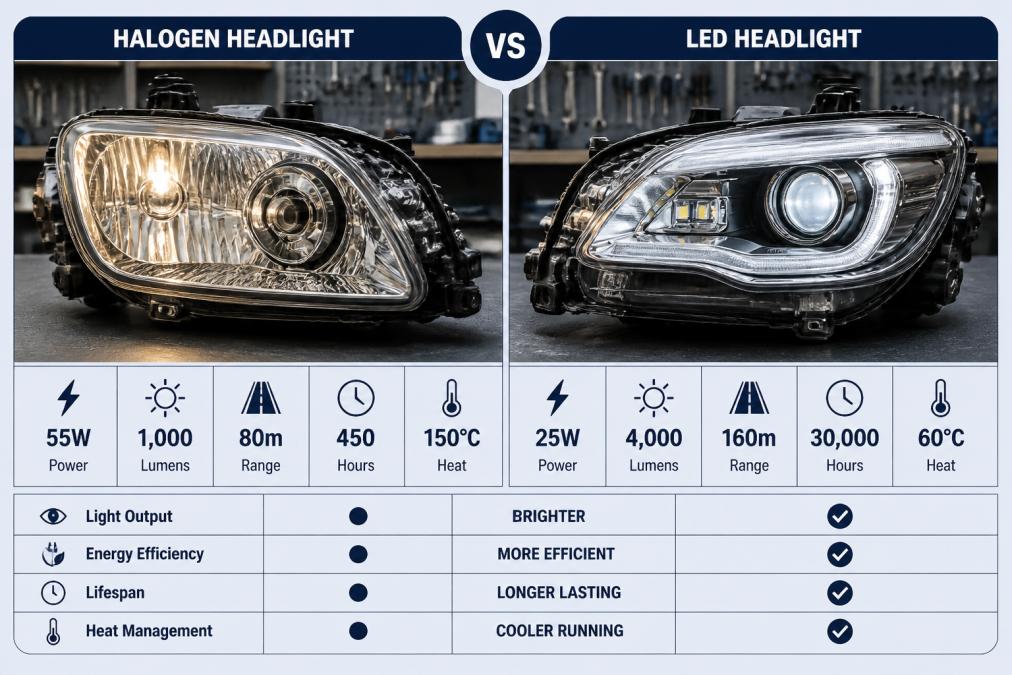
LED headlights use semiconductor diodes to produce light, while halogen bulbs heat a tungsten filament until it glows. That single difference explains almost every advantage LED has: lower power consumption, longer life, and less heat.

Brightness, Beam Pattern and Glare Control
Halogen bulbs lose intensity over their life as the filament degrades, so a two-year-old bulb is dimmer than a new one. LED units hold their output far more consistently. The bigger issue is beam pattern: a poorly designed LED in a halogen housing scatters light upward and blinds oncoming drivers rather than lighting the road.
What most guides miss is that brightness alone means nothing without beam control. A focused, correctly aimed LED beam puts light on the road where you need it. A scattered one just creates glare.
Heat Output and Thermal Management
Halogen bulbs waste most of their energy as heat, which is why the glass gets too hot to touch. LEDs run cooler at the emitter but still need thermal management, usually an aluminium heat sink, to move heat away from the diode. That's why quality LED assemblies are built from materials like PMMA, ABS, and aluminium.
LED Headlights Power Consumption: What It Means for Your Alternator and Battery
LED headlights power consumption is typically a fraction of what halogen bulbs draw for the same or better light output. That reduced electrical load matters more than most drivers realise, but the honest version of the story requires understanding where the current actually goes.
Your alternator generates electricity to run the vehicle and recharge the battery. Every watt the headlights don't use is a watt available elsewhere: the sound system, phone charging, or simply less strain on the charging system during short trips. The alternator is belt-driven, so it imposes a small mechanical drag on the engine whenever it is generating current.
Real-World Energy Savings at the Vehicle Level
A common mistake is judging savings by the bulb alone. In practice, the vehicle-level benefit comes from running brighter lights at lower current, which reduces the continuous load on the alternator. For electric vehicles, every reduction in electrical draw feeds back into driving range, however modestly.
We wouldn't oversell this. The gain per vehicle is real but small. Where it compounds is across a fleet or over years of ownership, alongside the reduced replacement frequency.
What the Numbers Actually Look Like
Rather than quote a single headline figure, it helps to understand the mechanism. A halogen headlight bulb typically draws in the order of several amps at 12 volts; a comparable LED unit draws a fraction of that for equivalent or better light output. Multiply the difference across two low beams, two high beams and any auxiliary lighting, and the continuous saving is meaningful in electrical terms even if the fuel saving is small.
Three practical consequences follow:
- Alternator load. A lower continuous draw means the alternator works less hard, which is most noticeable on vehicles with marginal charging systems or heavy accessory use.
- Battery demand. Short-trip drivers who never fully recharge the battery benefit from a lower baseline drain, particularly in cold weather when battery capacity drops.
- EV range. On an electric vehicle, lighting is a small but non-zero part of the auxiliary load. Reducing it contributes to range in the same way that reducing cabin heating or air conditioning does, incrementally.
Why the Savings Are Often Overstated
Some marketing claims imply that switching to LED lighting will noticeably cut fuel consumption. That is not a realistic expectation for a single vehicle. The honest framing is that LED lighting reduces electrical load, and reduced electrical load has a small positive effect on the charging system and, in an EV, on range. The larger financial benefit usually comes from lifespan and replacement frequency rather than fuel.
If you want to verify the effect on your own vehicle, a clamp meter on the headlight circuit before and after the change will show the current difference directly. That is a more reliable measure than any generic claim.
LED Headlight Lifespan: Fewer Replacements, Less Fiddling
LED headlight lifespan is measured in tens of thousands of hours, far beyond what a halogen filament manages. For most drivers, that means the headlight assembly outlasts the car.

Fewer replacements means less time under the bonnet, fewer trips to the parts counter, and less money spent on bulbs over the life of the vehicle. It also means consistent performance: no gradual dimming before a bulb finally fails.
Autoglo Australia LED Headlights For Lexus RX330 RX350 RX400h 2003-2009 Start →
Durability, Vibration Resistance and Cold-Weather Performance
LEDs have no filament to break, so they handle vibration and rough roads far better than halogens. Cold-weather performance is another quiet advantage: halogens can dim in extreme cold, while LEDs start at full output.
Quality assemblies back this up with sealed housings.
Aftermarket LED Headlight Legality Australia: What You Need to Know Before You Buy
Aftermarket LED headlight legality in Australia comes down to whether the lights meet the relevant standards and produce a compliant beam pattern. Brightness isn't the test. Beam pattern, colour, and glare control are.
Vehicle Standards Bulletin on lighting outlines the requirements that aftermarket lighting must meet. A light that's too bright, wrongly aimed, or the wrong colour can fail a roadworthy inspection or attract a defect notice.
The safest path is buying assemblies designed for your specific model with proper certification. Our LED headlights for the Lexus RX330, RX350 and RX400h (2003-2009) carry DOT and E-Mark certification, so you're not gambling on compliance.
Compatibility, Installation and Total Cost of Ownership
Compatibility is where most aftermarket purchases go wrong. A bulb that physically fits can still trigger dashboard error messages or throw the beam pattern out. The reliable answer is a complete assembly engineered for your model and trim.
Fitment, Polarity and CAN Bus Errors
Three failure modes account for most aftermarket lighting complaints:
- Physical fitment. A bulb may seat in the housing but sit at the wrong depth or angle, which ruins the beam pattern even though it lights up.
- Polarity. Some vehicles use reversed polarity at the connector; a bulb wired the wrong way simply won't illuminate, and the fix is a connector swap rather than a new bulb.
- CAN bus errors. Modern vehicles monitor bulb resistance and will flag a fault or trigger hyper-flash when the resistance changes. A quality assembly with a built-in driver avoids this; a bare drop-in bulb often does not.
Other symptoms to watch for include flicker at low brightness, radio interference, and heat sinks that foul the housing cover. None of these are reasons to avoid LED lighting, they are reasons to buy a complete, model-specific assembly rather than a generic bulb.
Installation: What Plug-and-Play Really Means
Installation on a proper assembly is usually plug-and-play. Our Lexus RX and Toyota Highlander, 4Runner, and Corolla LED headlight assemblies are designed as direct replacements with no rewiring or coding required, which means most owners can fit them at home.
That said, professional installation is worth considering when the bumper or housing must be removed, when the vehicle has complex CAN bus monitoring, or when you are unsure about beam aiming. Aiming is not optional: a correctly built assembly still needs to be aimed after fitting, and a workshop with a beam setter will do this more accurately than a wall and a torch.
Total Cost of Ownership and Payback
On total cost of ownership, the maths favours LEDs over time. A halogen setup is cheaper upfront but needs repeated bulb replacements, and each one costs money and time. A quality LED assembly is a larger one-off purchase that spreads across years of use, backed by a 1-year manufacturer warranty on our range.
The payback calculation depends on three variables: how much you drive at night, how long you keep the vehicle, and whether you pay someone to fit replacements. A high-mileage night driver who pays for labour will reach break-even far sooner than a low-mileage daytime driver who fits bulbs themselves.
| Factor | Halogen | LED Assembly |
|---|---|---|
| Upfront cost | Lower | Higher |
| Replacement frequency | Frequent | Rare |
| Power draw | Higher | Lower |
| Heat output | High | Managed |
| Beam consistency | Degrades | Stable |
| CAN bus compatibility | Native | Depends on assembly |
| Aiming required after fit | Yes | Yes |
Conclusion: Choosing Energy Efficient Car Lighting That Fits Your Vehicle
The challenge with energy efficient car lighting isn't finding bright bulbs. It's finding a compliant, properly fitting system that delivers the savings and visibility without the glare, error codes, or failed roadworthy that come with the wrong choice. Autoglo Australia stocks premium LED headlights engineered for specific makes and models, with plug-and-play installation, IP67 waterproof housings, and DOT and E-Mark certification. Browse our range and upgrade your vehicle with lighting that's built to perform and built to last.
Frequently Asked Questions
Do LED car lights use less electricity than halogen lights?
Yes, and the difference is significant. A typical halogen headlight bulb draws around 55 watts, while an equivalent LED unit often uses 20 to 30 watts for the same or better light output. Across a pair of headlights plus other exterior lighting, that adds up to a meaningful reduction in electrical load on your alternator and battery. For energy efficient car lighting benefits, lower power consumption is one of the most measurable improvements you will notice.
Are aftermarket LED headlights legal for road use?
Aftermarket LED headlights can be legal if they meet the relevant vehicle standards, including correct beam pattern, colour temperature and glare control. Products carrying E-Mark or DOT certification, like the Autoglo Australia range, are designed to comply with road safety standards. Always check your state or territory road authority requirements and ensure the lights are fitted correctly and aimed properly before driving.
Do LED headlights last longer than halogen headlights?
LED headlight lifespan typically runs into tens of thousands of hours, compared with around 1,000 to 2,000 hours for a halogen bulb. That means far fewer replacements over the life of your vehicle. LED units are also more resistant to vibration and shock, which is common on rough roads. The result is less maintenance and more consistent performance over time.
Will upgrading to LED headlights improve my visibility at night?
A quality LED upgrade delivers brighter, whiter light with a more focused beam pattern, which improves hazard detection and reduces eye strain on dark roads. Colour temperature closer to daylight helps your eyes pick out road markings and obstacles sooner. The key is choosing a properly engineered unit with good beam control rather than a cheap bulb swap, which can scatter light and cause glare for other drivers.