

Table of Contents
- How to Check Headlight Bulb Compatibility: A Step-by-Step Guide
- Start With Your Owner's Manual or Service Manual
- Read the Bulb Number and Markings on the Existing Bulb
- Use a Bulb Finder or Fitment Guide by Make, Model, and Year
- How to Test a Headlight Bulb With a Multimeter Before You Buy
- Why Do LED Headlights Cause Battery Drain?
- ADR Headlight Compliance Standards and What They Mean for Fitment
- Verification Checklist: Cross-Checking Sources Before You Commit
- Frequently Asked Questions
Last Updated: October 7, 2026
How to Check Headlight Bulb Compatibility: A Step-by-Step Guide
Headlight bulb compatibility is the process of confirming that a replacement globe physically fits your socket, works with your car's wiring, and meets the rules for use on the road.
At Autoglo Australia, we field this question daily: "will this fit my car?" The honest answer is that fitment is rarely just about the bulb number.
So before you buy anything, you need a way to check. Below, we'll show you exactly how to confirm bulb compatibility using four independent sources, and how to spot the mismatches that trip up most buyers.
Start With Your Owner's Manual or Service Manual
Your owner's manual is the fastest starting point, and for a base-model car it's usually right. Look for a "replacement bulbs" or "light bulbs" table near the end of the book, or in the glovebox supplement.
That table lists the bulb type for each function:
- Low beam
- High beam
- Front turn signal
- Fog lights
- Parkers
- Daytime running lights, where fitted
Write down every code you find. A car might use H4 for one function and H7 for another, so don't assume one bulb covers the lot.
Why the manual alone is not enough
Manuals are printed for a model range, not your specific car. Three things routinely change what actually fits:
- Trim level. A base variant may ship with a halogen reflector headlamp, while a higher trim of the same model and year uses a projector assembly with a different globe and connector. The manual often prints only the base spec.
- Build date and mid-cycle updates. Manufacturers run "series" or "phase" updates within a single model year. A headlamp assembly can change at a specific production date, so two cars registered in the same year can take different bulbs. Your compliance plate or build date sticker tells you which side of the change you're on.
- Factory options. HID or LED headlamps fitted as an option, or bundled in a technology pack, use entirely different globes (often D-series for HID) and often a ballast or driver module the base car doesn't have.
A common pattern is a buyer checking the manual, buying the listed halogen globe, and finding it won't seat because their car left the factory with the projector assembly. The manual wasn't wrong for the model, it was wrong for that car.
How to confirm the manual against your actual car
- Note the bulb code the manual lists for the function you're replacing.
- Check your build date against any model-year or series change for your vehicle.
- Confirm the housing type by looking at the lens: a clear round or oval projector lens versus a fluted reflector bowl.
- Cross-check the code against the bulb physically fitted (see the next section).
If you don't have the book, most manufacturers publish the same table online, and a dealer parts desk can confirm the correct globe from your VIN, which is the most reliable single source because it ties to the exact build, not the model range.
Read the Bulb Number and Markings on the Existing Bulb
The bulb already in your car is the most reliable source you have. It physically fits, it works, and it's sitting in front of you.
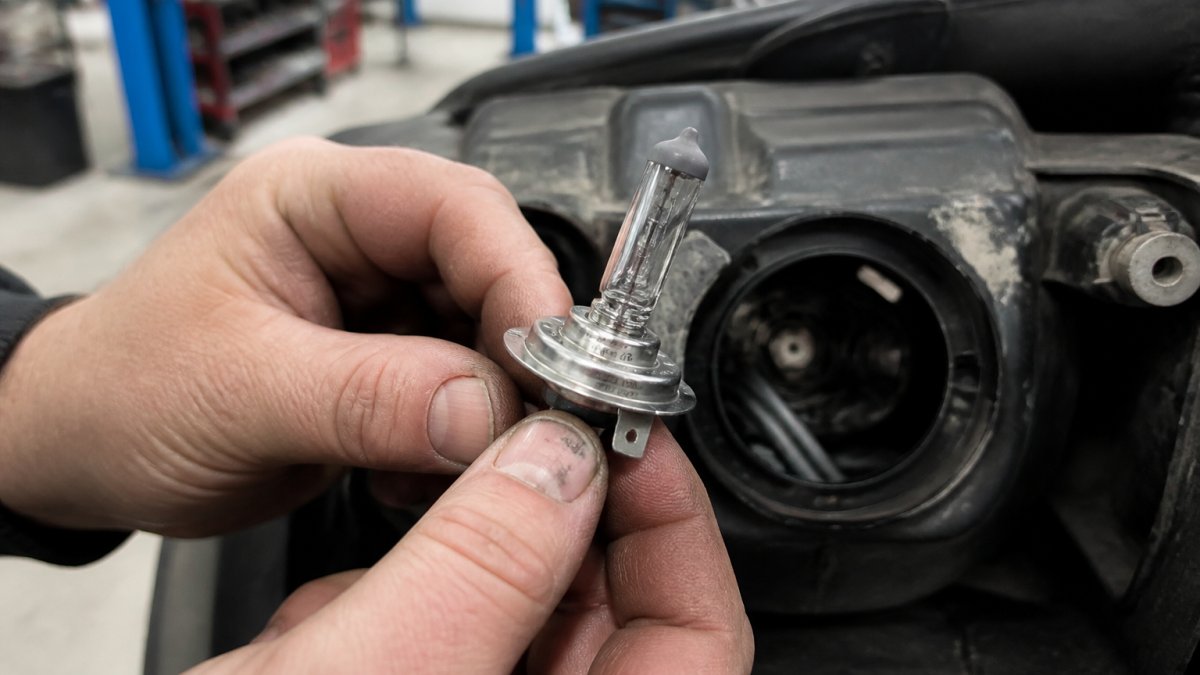
Pull the globe and look at the metal base or the plastic collar. You'll normally find:
- The bulb code, such as H4, H7, H11, or D2S
- The wattage, commonly 35W or 55W
- The voltage, usually 12V
- Certification or maker marks
Photograph the markings before you put the bulb back. It saves a second removal later.
Watch for these traps:
- Faded or worn markings. If you can't read the code, don't guess from the shape alone.
- Previous owner swaps. Someone may have already fitted an aftermarket globe that isn't the factory type. Cross-check against the manual.
- Mismatched pairs. If the left and right bulbs carry different codes, one side has been replaced with the wrong part.
Use a Bulb Finder or Fitment Guide by Make, Model, and Year
A bulb finder narrows the options fast, but it's a starting point, not a final answer. These tools work by matching your make, model, year, and often your trim or engine variant against a fitment database.
Here's how to get the most from one:
- Enter your full vehicle details, including trim and body style.
- Note every bulb type the tool returns for your car.
- Compare that list against what you found in the manual and on the existing bulb.
- If the tool asks for a registration lookup and your state or territory offers one, use it to confirm the exact variant.
Where the three sources agree, you can buy with confidence. Where they disagree, stop and dig further.
The disagreements are the useful part. A finder that lists H7 for your model may be matching the base trim, while your car has the projector assembly that takes a different globe entirely. That's exactly the kind of gap the next steps are designed to close.
How to Test a Headlight Bulb With a Multimeter Before You Buy
Testing with a multimeter confirms your car is delivering power correctly, which matters before you blame a new globe for not working. It won't tell you whether a bulb is compatible, but it will tell you whether the circuit is healthy.
Total Time: 20 minutes Difficulty: Beginner
What You'll Need
- A digital multimeter
- The bulb you want to test
- Safety glasses and gloves
- Your vehicle's wiring diagram or a workshop manual
Step 1: Test the Bulb for Continuity [Time: 5 minutes]
Set the multimeter to resistance or continuity mode. Touch one probe to each contact on the bulb base. A working filament or circuit shows a reading or a beep. No reading means the bulb is dead.
Autoglo Australia For 2X D3R Headlight Light Heavy Duty Premium Xenon 6000K →
Step 2: Check the Socket Voltage [Time: 10 minutes]
With the headlights switched on and the engine running, probe the socket contacts. You should see close to 12V. A reading well below that points to a wiring, relay, or earth problem rather than a bulb problem.
Step 3: Inspect the Connector [Time: 5 minutes]
Look for corrosion, melted plastic, or loose pins. These cause intermittent faults that mimic a failing bulb.
Expected Result: You'll know whether the fault sits with the bulb, the socket, or the wiring. That tells you whether a replacement globe will actually solve your problem.
Why Do LED Headlights Cause Battery Drain?
LED headlights cause battery drain when the setup draws power while the car is switched off, usually through a faulty canbus adapter, a cheap driver module that never fully sleeps, or a wiring error.
Here's what's actually happening:
- Canbus adapters that stay energised after shutdown
- Driver modules with poor sleep behaviour
- Incorrect wiring that leaves a circuit live
- Error-cancelling resistors that generate heat and draw current continuously
If your battery goes flat overnight after a lighting upgrade, disconnect the new modules and see if the drain stops. That single test tells you whether the upgrade is the cause.
When you buy globes, look for canbus-ready products. Our D3R xenon globes are built canbus compatible to avoid dashboard errors, which removes one of the most common causes of warning lights after a swap.

ADR Headlight Compliance Standards and What They Mean for Fitment
Australian Design Rules set the requirements your vehicle's lighting must meet to be road legal. For headlights, that covers beam pattern, brightness, colour, and glare control. A globe can fit perfectly and still be non-compliant.
That distinction catches people out. Physical fit and legal fit are two different things.
What to check:
- Beam pattern. Drop-in LED globes in a halogen reflector housing often scatter light and dazzle oncoming drivers.
- Colour temperature. Very blue or purple output can fall outside the allowed range.
- Housing type. LED and HID conversions are generally suited to projector housings, not reflector ones.
- Self-levelling and washers. Some high-output systems require these to stay compliant.
The National Transport Commission publishes guidance on vehicle standards, and your state or territory road authority handles inspections. Always confirm current requirements with the relevant authority before you buy, because the rules and enforcement vary.
For a compliant upgrade path, a purpose-built assembly beats a bulb swap. Our VLAND projector headlights for the Volkswagen Golf 6 are a direct plug-and-play replacement with OEM connections, running LED low and high beam, LED running lights, and amber sequential indicators.

Verification Checklist: Cross-Checking Sources Before You Commit
Use this checklist before you pay for anything. If a box doesn't get ticked, keep digging.
- Owner's manual bulb table checked and codes written down
- Existing bulb removed and markings photographed
- Bulb finder run with full make, model, year, and trim
- Registration or VIN lookup used where available
- All sources agree on the bulb code
- Socket and connector inspected for damage
- Housing type confirmed: reflector or projector
- Wattage and voltage match the factory spec
- Canbus compatibility confirmed for your model
- Compliance with Australian Design Rules confirmed
| Symptom | Likely Cause | What To Do |
|---|---|---|
| Flickering after install | Canbus mismatch | Fit canbus-ready globes |
| Warning light on dash | Missing error canceller | Check adapter or module |
| Beam scatters, glare | Wrong housing type | Switch to projector assembly |
| Battery flat overnight | Module staying live | Disconnect and retest |
| One side dimmer | Mismatched bulbs | Replace as a pair |
Getting bulb compatibility wrong is an expensive habit, and it's usually avoidable with twenty minutes of checking. Confirm the bulb code from three sources, inspect the housing, and make sure the setup is canbus ready and compliant before you commit.
Autoglo Australia stocks many LED headlights, projector headlights, and tail lights across many makes and models, with monthly featured product sales and specialised accessories to match. If you're unsure what fits your car, send us your make, model, year, and trim, and we'll help you confirm the right part before you order.
Frequently Asked Questions
How do I know which headlight bulb fits my car?
Check your owner's manual first, then confirm by reading the markings on the bulb you remove. Cross-check the bulb number against a fitment guide using your vehicle's make, model, year, and trim. If your car has factory HID or LED assemblies, a standard halogen bulb will not work. Autoglo Australia stocks D3R, D2S, and D4R Xenon HID globes for vehicles already equipped with HID systems, with prices from $63.00.
What happens if I install the wrong headlight bulb?
An incorrect bulb may not seat properly in the socket, causing a loose connection or flickering. It can trigger dashboard warning errors, produce a scattered beam pattern that fails a roadworthy inspection, or damage the connector. In some cases the bulb simply will not illuminate. Always confirm bulb base type, voltage, and wattage match your vehicle's original specification before installation.
Are headlight bulb sizes universal?
No. Bulb bases differ by type, including H4, H7, D2S, D3R, and D4R, and each has a specific socket shape. Even within the same vehicle model, trim level and production date can change which bulb or headlamp assembly is fitted. Always verify using your vehicle's specific configuration rather than assuming a bulb that fits one car will fit another.
Can I use any LED bulb for my headlights?
Not necessarily. LED bulbs must match your socket type and work with your vehicle's CAN bus system to avoid dashboard errors. They also need to comply with ADR headlight compliance standards for beam pattern and colour temperature. If your vehicle was factory-fitted with HID xenon, a direct OEM replacement globe such as a D2S or D4R is the correct path rather than a generic LED conversion.